
By Mike Rockwell, Product Manager, SolarPro · Updated October 2026
Paint protection film (PPF), also called clear bra, is a transparent layer of thermoplastic polyurethane (TPU), about 6 to 10 mil (150 to 250 microns) thick, bonded over a car’s painted panels. It absorbs stone chips, blocks UV and chemical etching, and heals light scratches with heat, so the factory paint underneath stays original.
That is the short answer to what is paint protection film. The longer answer matters if you sell, install or specify film, because two rolls that look identical on a shelf can behave very differently after two summers on a car. We coat PPF on our own lines in Jiangsu, China, so this guide explains it from the factory side: what the film is made of, what each layer does, what it can and cannot protect, how it goes on, what drives the price, how long it lasts, and how to tell a good film from a cheap one before you put your name on it.
PPF at a Glance
If you only have a minute, this table covers the questions we hear most often from installers, distributors and car owners.
| Question | Short answer |
|---|---|
| What is it? | A clear, elastic thermoplastic polyurethane (TPU) film bonded over painted panels |
| Other names | Clear bra, clear PPF, invisible car cover, helicopter tape |
| How thick? | Usually 6–10 mil (about 150–250 µm); our clear range runs from 6.5 to 9.5 mil |
| What it protects against | Stone chips, scratches and swirl marks, UV fading, bird droppings, acid rain, tar |
| What it can’t stop | Cuts through the film, collision damage, dents, defects already in the paint |
| Does it heal? | Light scratches close with heat from the sun, warm water or a heat gun |
| How long it lasts | 5–7 years in our aging tests; real life depends on climate and care |
| Film per car | Front end 6–10 m; full body 18–25 m, on a 1,524 mm (60 in) wide roll |
| Main cost drivers | Coverage, film grade, labor time and how complex the car is |
What Is PPF on a Car? Definition, Other Names and Where It Came From
On a car, PPF is a sacrificial skin. It sits on top of the clearcoat, the transparent layer that gives factory paint its gloss and most of its resistance to weather. Clearcoat is hard, but it is thin and it cannot grow back. Once a stone punches through it or a wash brush cuts swirl marks into it, there are only two fixes: machine polishing, which removes more of it, or a repaint. PPF changes where the damage lands. The stone hits the film, the film spreads the energy, and the paint underneath stays as it left the factory.
If you came here looking for the PPF meaning in car care, that is all it is: a layer you can replace, protecting a finish you cannot.
Clear Bra, Clear PPF, Invisible Car Cover: Same Film, Different Names
You will hear several names for the same product, and buyers in different markets use different ones:
- Clear bra is the older American name. It comes from the vinyl “car bras” that used to strap over the front of cars to stop stone chips. Clear film did the same job without hiding the paint, and the name stuck.
- PPF and paint protection film are the names most manufacturers and installers use today.
- Clear PPF separates the transparent film from colored and matte versions.
- Invisible car cover is common in Asian markets, where the film is often sold as a “second skin” for new cars.
- Helicopter tape is the name older installers still use, for reasons that go back more than half a century.
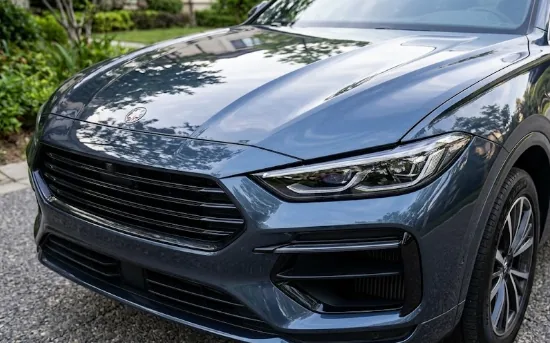
All of these describe a transparent TPU layer bonded over factory paint. Colored PPF and matte PPF use the same family of materials but change the look of the car as well as protecting it.
Where PPF Came From
Paint protection film was not invented for cars. During the Vietnam War, the rotor blades of US military helicopters were often damaged by flying debris and shrapnel, and the military asked 3M for protection that was light and close to invisible, according to the Wikipedia entry on paint protection film. The result was a clear polyurethane tape, which is why some installers still call PPF “helicopter tape”.
Racing drivers were among the first to put it on cars, to keep gravel from chewing up their paint. The early films did the job, but they were thick and stiff, because a rotor blade is a flat, simple surface. A car is not. Bumpers, mirror housings and hood edges curve in two directions at once, and a stiff film either refuses to follow them or lifts at the edges a few weeks later.
That shift from blades to bodywork has shaped every generation of film since. Protection was never the hard part. Making a film thin enough to look invisible, clear enough to disappear on dark paint and elastic enough to follow a bumper without lifting is what took decades, and it is why the industry ended up with elastic TPU and a functional top coat.
Four Generations of Protection Film
Knowing which generation a supplier is really selling is the quickest way to read a quotation that looks too cheap. This is how we group them:
| Generation | Material | What it got right | Where it fell short |
|---|---|---|---|
| 1st | Polyurethane (PU) film | High tensile strength and toughness for its time | No self-healing, poor abrasion resistance, low gloss |
| 2nd | PVC film | Cheap to make and easy to sell on price | Stiffens and weathers poorly, short service life, limited protection |
| 3rd | Uncoated TPU | The right base polymer: elastic, tough and clear | No functional top coat, so no self-healing or anti-fouling; yellowing and hydrolysis complaints |
| 4th | Coated TPU (today’s standard) | Aliphatic TPU body with a self-healing, anti-fouling top coat | Costs more to make; quality depends heavily on the TPU grade and the top coat |
PVC film still turns up in low quotations because it is cheap to produce, and some films sold as TPU are blends (often called TPH) that sit between PVC and TPU. Neither behaves like coated TPU once the car has been through a summer and a winter.
How PPF Works: Five Layers, Three Stay on the Car
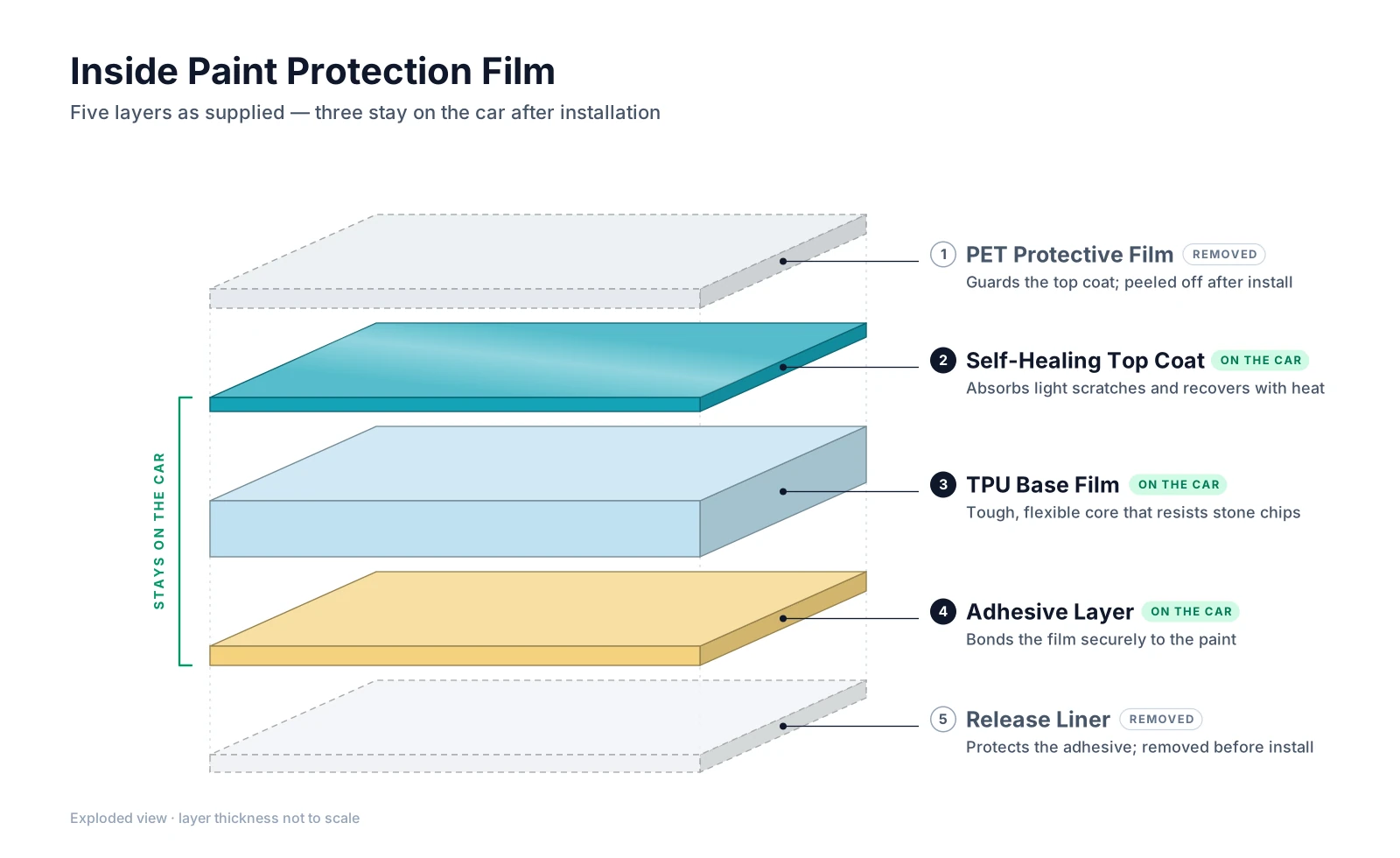
A roll of PPF leaves the factory as five layers. Two of them are carriers that the installer peels away. The other three stay on the car and do all the work for the life of the film.
| Layer | Typical thickness | Stays on the car? | What it does |
|---|---|---|---|
| PET protective film | 2 mil | No, peeled off during installation | Keeps the top coat clean through slitting, packing and shipping |
| Self-healing top coat | 0.5 mil | Yes | Closes light scratches under heat; low surface energy keeps grime from bonding |
| Aliphatic TPU base film | 6 mil | Yes | Absorbs and spreads impact energy; stays clear under UV |
| Acrylic pressure-sensitive adhesive | 1–2 mil | Yes | Floats on slip solution, builds to full bond over about 48 hours, removes cleanly |
| Matte PET release liner | 3 mil | No, removed as the film goes on | Keeps the adhesive flat and clean until installation |
Note: layer thicknesses are shown for our 6.5 mil grade. Thicker grades use a thicker TPU body; the top coat and adhesive stay the same.
When people quote “PPF thickness”, they should mean the top coat plus the TPU body, the part that ends up on the paint. A spec sheet that adds the liners into one big number is not lying, but it is not comparing like with like. The measured data for every grade we make is on our TPU paint protection film page; here we focus on what each layer contributes.
The TPU Body Absorbs the Impact
Thermoplastic polyurethane is the reason PPF works. It is tough enough to take a hit and elastic enough to stretch around a curved panel, and it recovers its shape after both. When a piece of gravel strikes the film at highway speed, the TPU deforms, spreads the force over a wider area and springs back. A clearcoat a fraction of the thickness has no such reserve, so the same stone that bounces off film can leave a crater in bare paint.
Elongation matters as much as strength. Our clear films stretch to at least 360% of their length before they break, which is what lets an installer cover a whole bumper in one piece instead of seaming it. A film that cannot stretch has to be cut into more pieces, and every extra edge is a place where dirt can collect and the film can start to lift.
The Top Coat Heals Light Scratches and Sheds Dirt
The top coat is a layer about half a mil thick, and it is not a hard shell. It is an elastic network with shape memory. A fingernail, a wash brush or a bag dragged across the trunk lip deforms that network instead of cutting it. Add heat from the sun, warm water or a heat gun, and the network returns to the shape it had before, taking the mark with it.
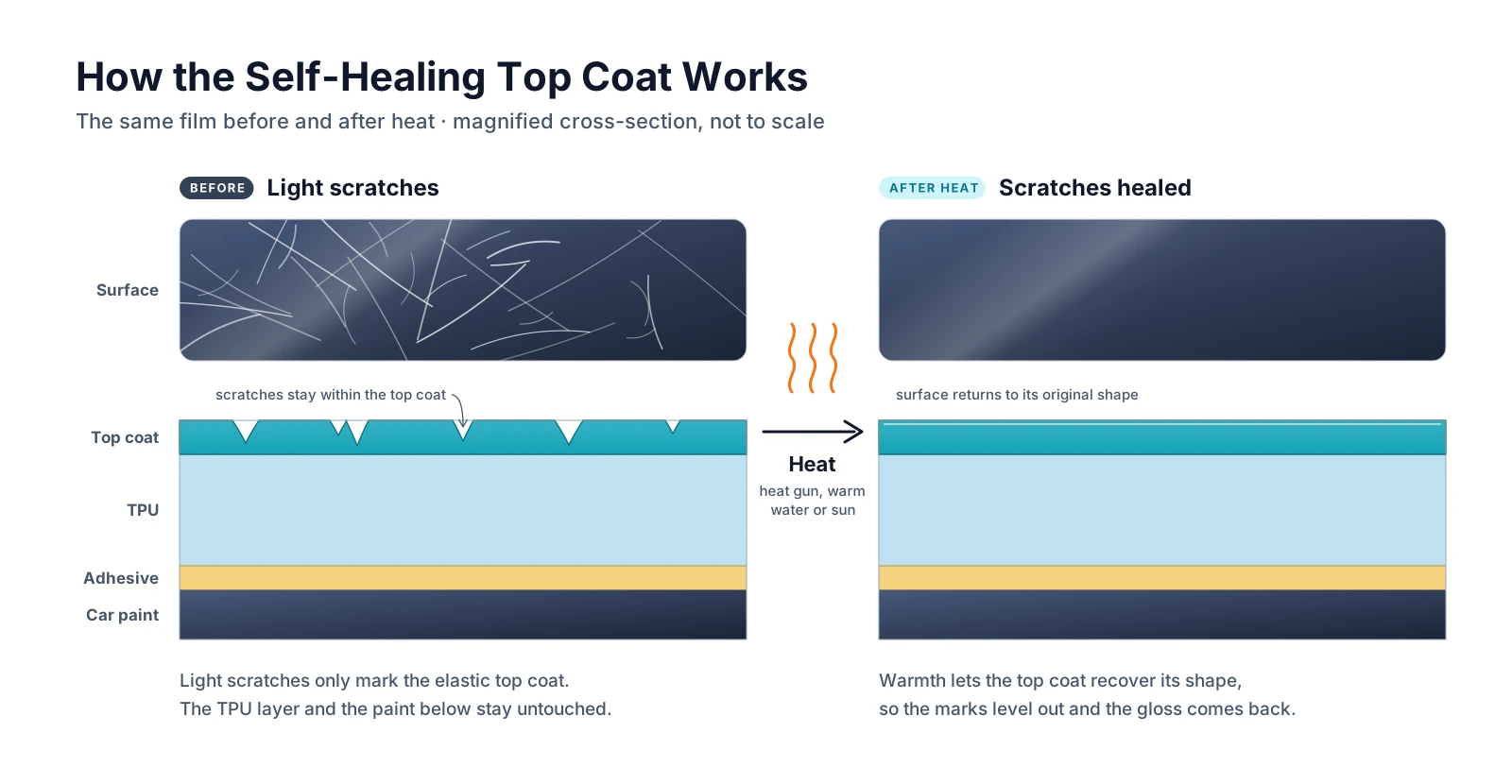
Self-healing has two limits. It covers marks in the top coat; a cut that goes through the film into the TPU or the paint will not close. And healing needs warmth, so in a cold workshop a light scratch can stay visible until the panel is warmed.
The same layer keeps the film clean. Its low surface energy means fuel, oil, bird lime and road grime sit on the surface instead of soaking in. On our film, that anti-fouling behavior is built into the polymer when the coating is made. The common shortcut is a silicone additive, which looks just as good in the first weeks and then washes away over a few months.
The Adhesive: Repositions Wet, Bonds in 48 Hours, Removes Clean
PPF goes on wet. The installer sprays a slip solution onto the paint and the adhesive side of the film, which lets the film float so it can be positioned, stretched and pulled back if needed. A good adhesive is designed for exactly this stage. Its initial grab is low enough that one person can position a full hood panel alone, and it keeps working in cold-weather installs.
Once the solution has been squeegeed out, the bond builds over about 48 hours. That is why installers ask owners to leave the edges alone for two days. Years later, when the film is due to come off, a well-formulated acrylic adhesive releases with heat and leaves no residue and no ghost image on the paint. Cheap adhesives are where many warranty claims start, either because they let go early or because they will not let go at all.
Why Aliphatic TPU Doesn’t Yellow
Not all TPU ages the same way. Yellowing usually starts when benzene rings in an aromatic polyurethane oxidize under UV and form colored compounds. Aliphatic polyurethane has no benzene ring to oxidize, so it stays clear far longer. For our clear film we use a polycaprolactone-type aliphatic TPU, chosen because it combines UV stability with resistance to hydrolysis and stays tough in cold weather.
We check this rather than assume it. Samples of our clear film go into a QUV weathering chamber fitted with UVA-340 lamps, and across our tests the yellowness index of our aliphatic TPU film has risen by an average of only 1.13 (ΔYI). A yellowness figure means little without the exposure hours and the method behind it, so we send the full report with the number rather than quoting it on its own.
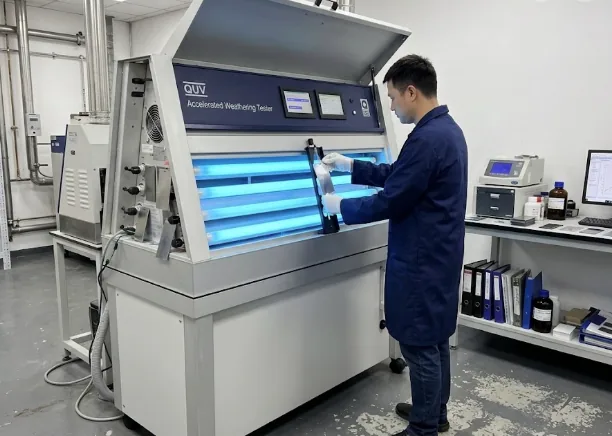
This kind of accelerated weathering is standardized in ASTM G154, the practice for fluorescent UV lamp apparatus that reproduces the effects of sunlight and of rain or dew. The UVA-340 lamp is the type used to approximate the short-wave UV in sunlight, which is the part of the spectrum that does most of the damage to polymers. A chamber cannot predict the exact year a film will yellow on a car in Dubai or Oslo, but it is very good at separating films that will hold up from films that won’t.
Why Coating PPF Is Harder Than It Looks
TPU is soft, and that makes it awkward to coat. Put the top coat straight onto bare TPU and two things go wrong. The solvent in the coating makes the TPU swell and then shrink, and in the drying oven the TPU and its PET carrier shrink at different rates. The web comes out wrinkled and will not wind into a clean roll, and a roll that cannot be wound flat cannot be sold.
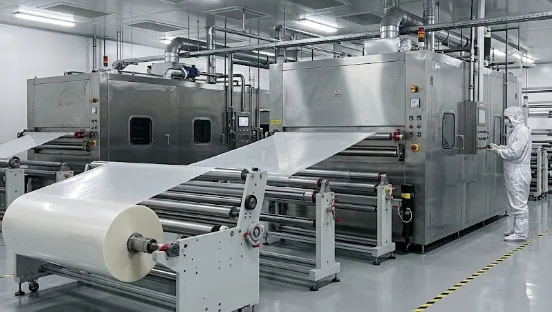
Our answer was to keep the TPU laminated flat to a PET support all the way through coating and drying, so the two layers move together in the oven instead of pulling against each other. The web leaves the oven flat and winds cleanly, and that is what gives our three coating lines a high first-pass yield. All five layers are brought together inside a cleanroom, with Class 100 conditions at the coating heads.
This is invisible to an installer, but it shows up in the roll. Film that was coated under stress carries that stress with it, and it can shrink back from edges or show waviness once it is on the car.
What Paint Protection Film Protects Against
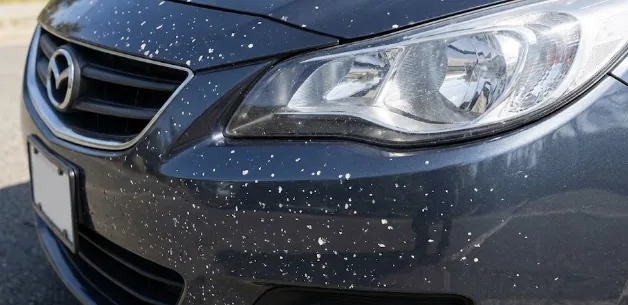
PPF exists to take four kinds of damage that factory paint handles badly. Each one ends in the film instead of the clearcoat.
| Threat | Without PPF | With PPF |
|---|---|---|
| Stone chips | Gravel can punch through the clearcoat into the primer; the fix is touch-up paint or a repaint | 6.5–9.5 mil of elastic TPU absorbs and spreads the impact |
| Scratches and swirl marks | Marks cut into the clearcoat and can only be polished out | Light marks sit in the top coat and close with heat |
| UV and oxidation | Pigment and resin break down; paint fades and chalks | UV-stable aliphatic film shields the paint underneath |
| Bird droppings, acid rain and tar | Acidic deposits can etch the clearcoat within hours in summer heat | Contamination sits on the film and wipes off |
Stone Chips
Stone chips are the main reason people buy PPF. The front bumper, the leading edge of the hood, the front fenders, the mirror housings and the headlights meet road gravel first, and at highway speed even small stones hit hard enough to break through paint. The auto industry measures how well paint survives this with a gravelometer test described in SAE J400, which fires gravel at coated panels to reproduce what the road does to the front of a car. A chip in bare paint is not just cosmetic: once it reaches metal, it can start to rust.
Scratches and Swirl Marks
Automatic car-wash brushes, gritty wash mitts, bags dragged over the trunk lip and fingernails around door handles all cut fine scratches into clearcoat. On paint, the only cure is polishing, and every polish removes a little more of a finish that is already thin. On film, light marks stay in the top coat and close with heat.
UV and Oxidation
Ultraviolet light breaks down the pigment and resin in paint over time, which is why cars parked outside in hot climates fade and chalk. Aliphatic TPU is UV-stable by chemistry, so the film shields the paint instead of yellowing over it.
Bird Droppings, Acid Rain and Tar
Bird droppings are acidic, and in summer heat they can etch a mark into clearcoat before the owner even sees them. Industrial fallout, tree sap, tar and insect remains do similar damage. On film they sit on top of the low-energy surface and wash off, and if something does leave a mark, it is in a layer you can replace.
What PPF Can’t Do: The Honest Drawbacks
PPF is very good at one job, and that job has clear limits. Car owners who know the limits are happier customers, and installers who explain them get fewer complaints.
- It cannot stop everything. A large stone at speed or a sharp object can cut through the film. Self-healing does not repair cuts, so the damaged panel’s film has to be replaced.
- It does not prevent dents or collision damage. The film protects the surface, not the metal or plastic underneath.
- It seals in whatever is already there. Swirl marks, chips and contamination left on the paint are locked under the film. Paint correction has to come before installation, not after.
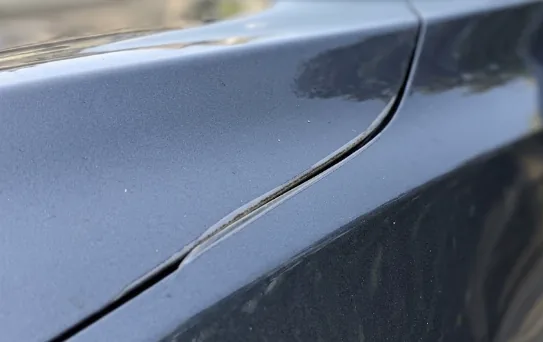
- Edges can show. On installs where the film stops on a visible face of a panel, you may see a fine line up close. Wrapping the edges around the panel hides them, but it takes more skill and more film.
- Quality varies widely. Low-grade films can yellow, crack or lift within a few years, and cheap adhesives can leave residue when they come off.
- The result depends on the installer. Even the best film looks poor if it is installed in a dusty bay or stretched too far.
- It costs real money up front. A full-body install is a significant purchase, so the value depends on the car and how long the owner keeps it.
- Removal is a job for a professional. Taking film off safely takes heat, time and technique.
- It is not for glass. Windows take automotive window film, which is a different product with different optical requirements.
Types of PPF: Finish, Surface and Thickness
Most PPF is clear and glossy, but the category now covers several finishes, two kinds of top coat and a range of thicknesses. Each choice changes how the car looks, how it cleans and how much protection it gets.
Clear, Matte and Colored PPF
Clear gloss PPF is the standard. It is optically clear and keeps the factory color exactly as it is, and many owners find the paint looks deeper and glossier under it.
Matte and satin PPF are clear films with a textured top coat. They turn a gloss finish into a satin one, or preserve the look of a car that left the factory with matte paint. They need slightly different care, because a matte surface cannot be polished or waxed.
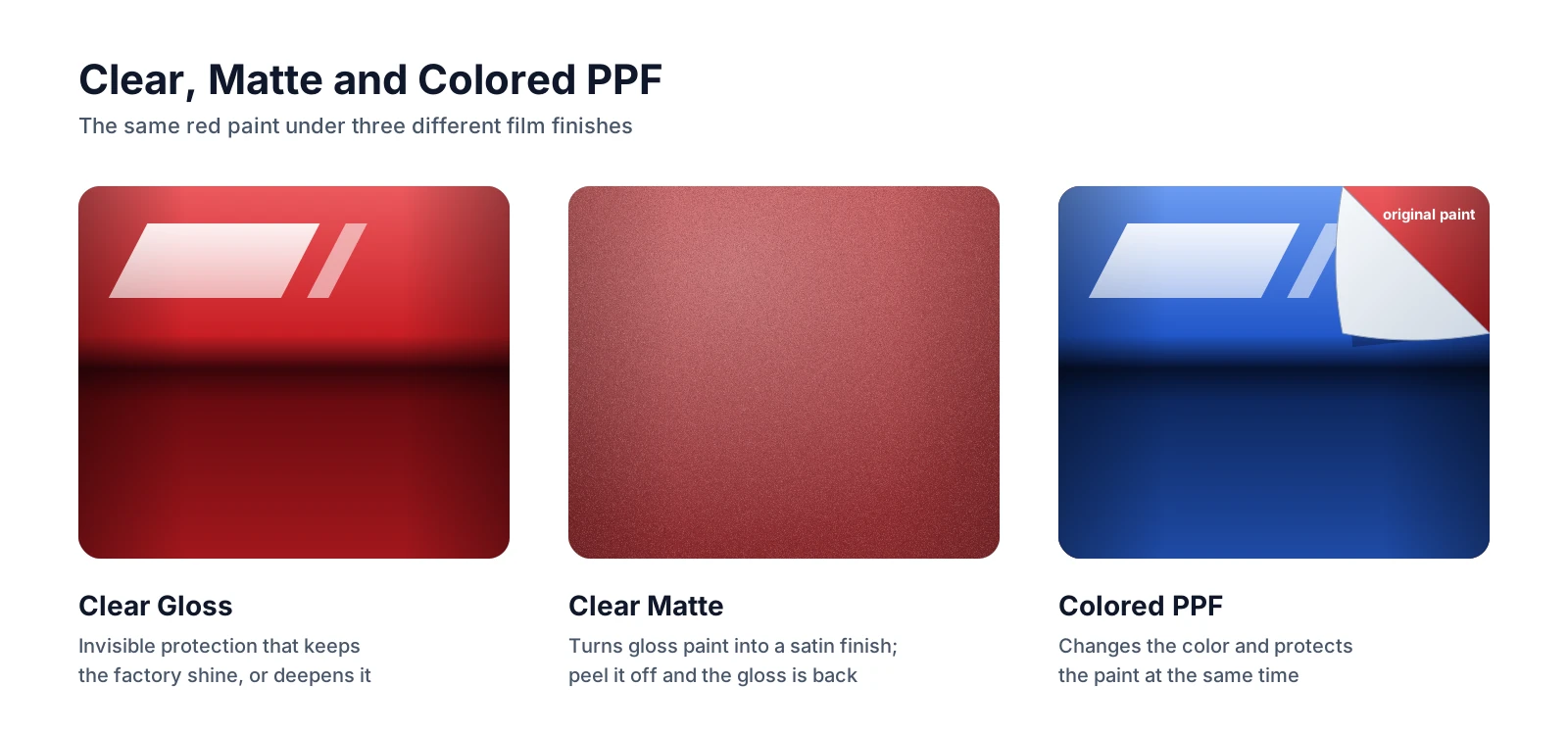
Colored PPF goes one step further. Pigment is built into the film so it changes the car’s color and protects the paint at the same time, which is why wrap shops increasingly offer it as a longer-lasting alternative to vinyl. On our colored PPF, the pigment is co-extruded into the TPU itself rather than printed or coated onto it, so the color goes all the way through the layer and does not separate when the film is stretched.
Hydrophobic or Hydrophilic Top Coat
The top coat also decides how water behaves on the film, and the difference is measured as the water contact angle, the angle a droplet makes with the surface.
- Hydrophobic PPF (contact angle above 90°) makes water stand up in beads and roll off, carrying loose dust with it. The car stays visibly cleaner between washes, which makes it an easy sell in wet climates and to owners who don’t wash often.
- Hydrophilic PPF (contact angle below 90°) spreads water into a thin, even sheet that dries evenly. Some installers prefer it because it leaves fewer drying spots, and owners who hand-dry their cars and dislike water marks often like it too.
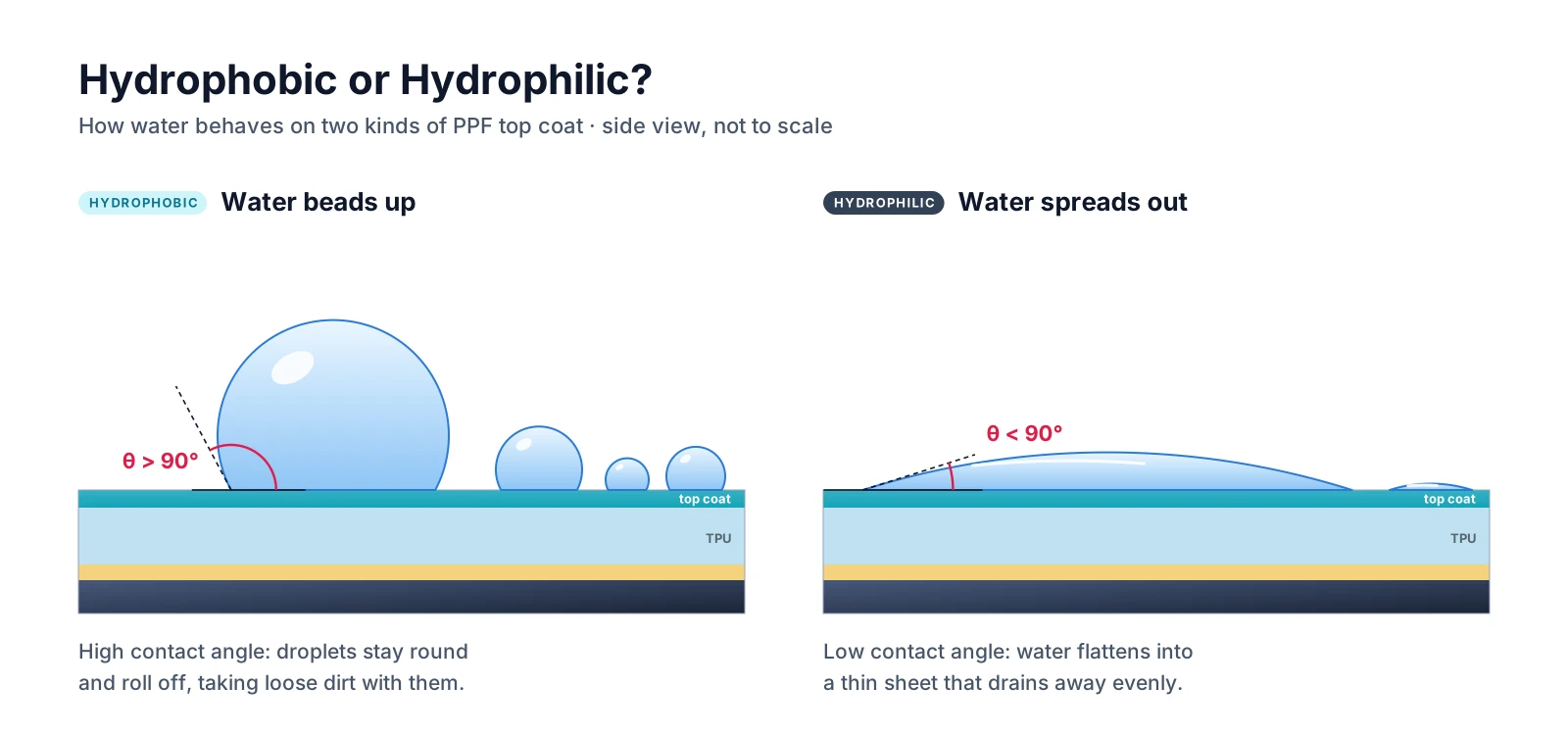
Neither is better in every case. For a distributor, the practical point is that the surface is a finish option on the same film, so you can stock both from one product platform and match them to your customers’ climate and habits.
Thickness: 6.5 to 9.5 Mil
Thickness is quoted in mil (thousandths of an inch); one mil is 25.4 microns. Thicker film absorbs more impact before the paint feels anything, but it is also stiffer to stretch and harder to wrap around tight edges. This is how our four clear grades compare:
| Property | HD-130 | HD-150 | HD-175 | HD-200 |
|---|---|---|---|---|
| Thickness | 6.5 mil (165 µm) | 7.5 mil (191 µm) | 8.5 mil (216 µm) | 9.5 mil (241 µm) |
| Tensile strength | 25 MPa | 28 MPa | 66 MPa | 70 MPa |
| Elongation at break | ≥360% | ≥360% | ≥360% | ≥360% |
| Shore hardness | 90 | 90 | 95 | 95 |
| Yellowness change (ΔYI) | 1.13 | 1.13 | 1.13 | 1.13 |
Note: all four grades come in 1,524 mm × 15 m rolls. The figures are averages from our factory laboratory under our standard test method, and we send the detailed report behind any figure on request.
For most markets, 7.5 mil is the mainstream choice: it has more impact reserve than 6.5 mil and is still workable enough for a full-body install. Thinner film suits price-led markets and installers still building confidence on complex panels. The heavier 8.5 and 9.5 mil grades make sense where gravel is routine, such as front-end packages on highway cars, fleet and work vehicles, and off-road use.
Where PPF Goes on a Car: Coverage Options
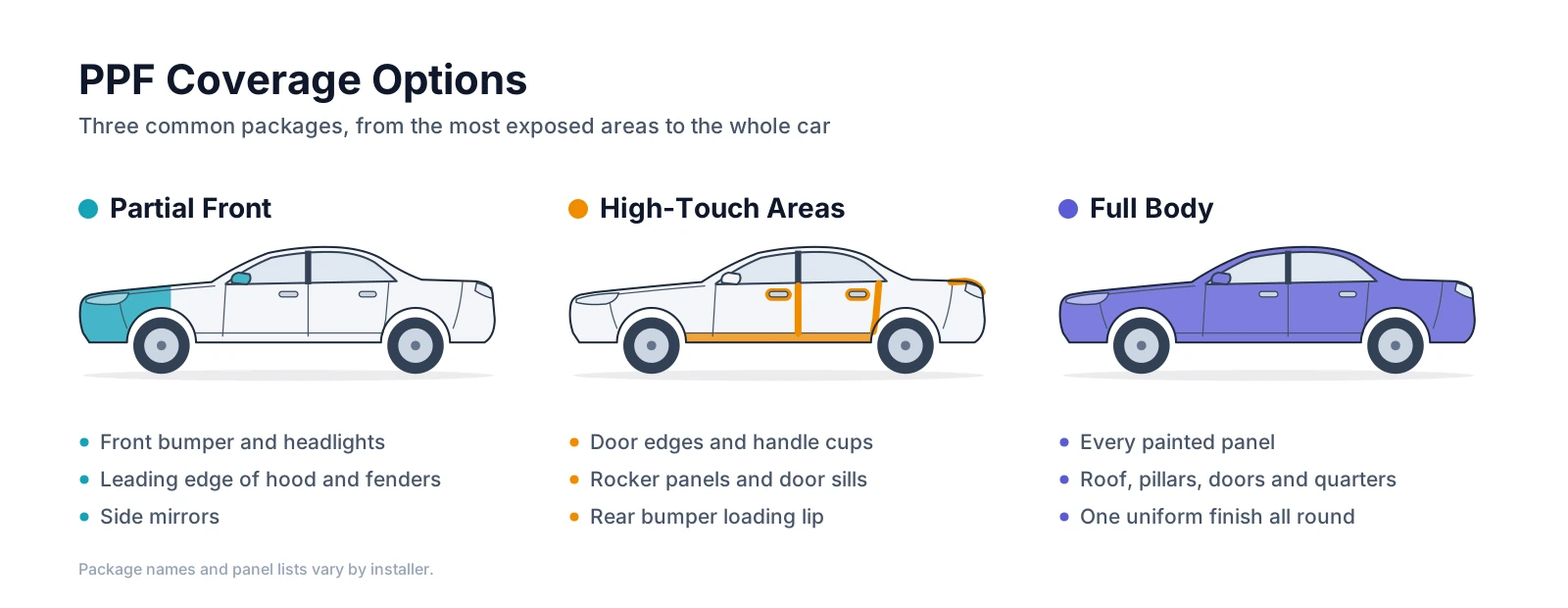
Coverage is what installers actually quote on, and it is the biggest single factor in price. Most shops build their menu around three packages:
| Package | Panels covered | Typical film used | Who it suits |
|---|---|---|---|
| Front end (partial or full front) | Front bumper and grille surround, hood leading edge or full hood, front fenders, mirrors, headlights | 6–10 m | Daily drivers who want chip protection where it matters most |
| High-touch set | Door handle cups, door edges, trunk lip and loading sill, rocker panels behind the wheels | 2–4 m | Any car; little film, high perceived value |
| Full body | Every painted exterior panel, with edges wrapped so no cut line sits on a visible surface | 18–25 m | New, high-value or dark-painted cars, and owners keeping a car for years |
Note: these are typical ranges on a 1,524 mm wide roll. Actual use depends on the model, the pattern set and how much offcut the cutting method leaves.
A front-end package is the most common starting point, and it often turns into a full-body sale later once the owner sees how well the film hides. Headlights are worth including in any front package: the polycarbonate lenses pit and haze from road debris, and film keeps them clear. Glass is the one area PPF does not cover; windows and windshields take window film instead.
How PPF Is Installed
Film quality sets the ceiling, but installation decides whether you reach it. This is the sequence our training program teaches the install centers we supply.
- Prepare the bay and the paint. Work in a clean, enclosed bay, ideally held at 20–25 °C. Wash, clay and degrease every panel, and correct any swirl marks or defects, because anything left on the paint is sealed under the film for years.
- Pattern and cut. Cut the pattern for the specific model before it goes on, or trim it by hand on the panel. Good patterns carry a wrap margin so the edges tuck around the panel instead of stopping on a visible face.
- Wet and position. Spray slip solution onto the paint and the adhesive, then float the film into place. A well-made adhesive lets one installer place a full hood panel alone.
- Squeegee and wrap. Drive the solution out from the center toward the edges, then warm and wrap the edges so no cut line sits on a visible surface.
- Inspect and hand over. Inspect the car before it leaves, then check it again about a week later, once the bond has reached full strength and any trapped moisture has gone.
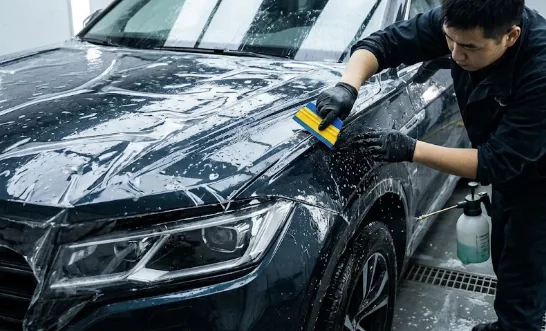
A front-end package usually takes a day or two once paint preparation is included, and a full-body install typically takes several days. Most of that time goes into preparation and careful edge work, not into laying the film. Shops that cut patterns on a plotter waste less film and work faster on common models; shops that work from bulk rolls by hand have more freedom on unusual cars. Both can produce excellent results. What they cannot do is skip the preparation, which is why we recommend professional installation over DIY kits for anything larger than a small panel.
Cost, Lifespan and Value
What Drives the Price of PPF
The price of PPF is mostly the price of time and coverage, not just film. Four things decide it:
- Coverage. A front-end package uses roughly a third to half as much film as a full body and takes far fewer hours.
- Film grade. Thicker grades, premium top coats and colored or matte films cost more per meter.
- Labor. Paint correction, wrapped edges and complex bumpers add hours. On a full body, labor is usually the larger share of the bill.
- The car and the region. Large SUVs, sports cars with deep vents and local labor rates all move the number.
Published US price guides from 2025 and 2026 generally put a front-end package at roughly $1,500 to $3,000 and a full-body install at roughly $5,000 to $10,000, with large or complex vehicles above that. Treat those figures as a starting point, not a quote. For a closer look at where the money goes, see our breakdown of PPF prices by coverage.
A very low quote usually means one of three things: an older-generation film, thin coverage with exposed edges everywhere, or a rushed install. Any of them can cost more later, when the film yellows, lifts or leaves adhesive on the paint as it comes off.
How Long PPF Lasts in Real Use
Comprehensive aging tests put our PPF at five to seven years of service, and good-quality TPU film from established manufacturers is generally expected to last five to ten years. Where a given car lands in that range depends on how it lives:
- Sun and heat. A car parked outside in a hot, sunny climate ages film faster than a garaged car in a mild one.
- Washing habits. Gentle hand washing extends film life; harsh chemicals, abrasive brushes and pressure washers aimed at the edges shorten it.
- Installation quality. Over-stretched film, contaminated paint and poorly finished edges are the usual causes of early failure.
- Film quality. Aromatic TPU, cheap adhesives and additive-based top coats age first.
The signs that film is reaching the end of its life are easy to spot: yellowing or haze, edges that start to lift, fine cracking in the surface, and scratches that no longer heal with heat. At that point the film should come off and be replaced, ideally before it becomes brittle and harder to remove.
When PPF Pays for Itself
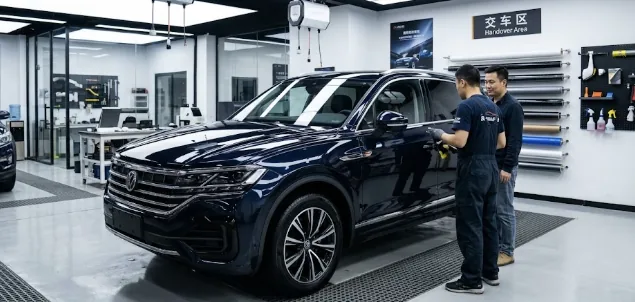
PPF makes the most financial sense when the cost of the paint it protects is high. That usually means:
- New cars, where the factory paint is perfect and worth keeping original.
- Leased cars, where chips and scratches turn into charges at the end of the contract.
- High-value and collectible cars, where original paint is a large part of the resale price.
- Dark paint colors, which show swirl marks and chips far more than silver or white.
- Cars that do a lot of highway driving, where stone chips accumulate quickly.
It makes less sense on an older car whose paint is already damaged, unless the paint is corrected first, or on a car the owner plans to sell within a year. For many owners, a front-end package is the practical middle ground: it protects the panels that take most of the damage at a fraction of the cost of a full body.
PPF vs Ceramic Coating vs Vinyl Wrap vs Wax
These four products are often sold side by side, and customers regularly confuse them. They do different jobs.
| PPF | Ceramic coating | Vinyl wrap | Wax or sealant | |
|---|---|---|---|---|
| What it is | Elastic TPU film | Liquid that cures into a thin, hard layer | Colored PVC film | Soft protective layer |
| Thickness | 6–10 mil | Microns, not mils | About 3–4 mil | Microscopic |
| Stops stone chips | Yes | No | Limited | No |
| Heals light scratches | Yes, with heat | No | No | No |
| Changes the color | Only colored PPF | No | Yes | No |
| Typical life | 5–10 years | About 2–5 years | Several years, by film grade | Weeks to a few months |
| Best for | Impact and scratch protection | Gloss and easy cleaning | Color change | Short-term shine |
The key difference is thickness. A ceramic coating is measured in microns and a PPF in mils, so only the film has enough material to absorb a stone. A coating, on the other hand, adds gloss and makes washing much easier, which is why many owners use both: film on the exposed panels, coating on top of the film and on the rest of the car. If you are deciding between them, our guide on how PPF and a ceramic coating work together goes through the options panel by panel.
Two practical rules apply when combining them. Put the film on first, because PPF should bond to bare clearcoat; a coating already on the paint has to be polished off the panels that will be filmed. And if you coat over the film, use a coating made for PPF and wait until the film has fully settled.
Vinyl wrap is a different product altogether. It is thinner, made of PVC rather than TPU, does not heal and offers limited protection; its job is to change the color. Colored PPF now does both jobs, at a higher price.
How to Care for Paint Protection Film
Most of what damages film in its first years is avoidable. These are the instructions we give install centers to hand to their customers:
- Allow 48 hours to bond. Some slip solution is still under the film at handover. Leave the edges alone while the adhesive reaches full strength.
- Expect small water pockets at first. Faint bubbles or haze from leftover moisture are normal early on and clear by themselves within days.
- Wait about a week before the first wash. After that, wash normally, but never aim a pressure washer straight at a film edge or seam.
- Choose touchless or hand washing. Use a pH-neutral shampoo and a clean microfiber mitt. Brush-type automatic washes are hard on any finish, film included.
- Keep stickers off the film. Badges, phone mounts and stickers stuck onto the film can lift it when they are removed.
- Skip abrasives and machines. Hard brushes, abrasive pads, polishing compounds, clay and polishing machines all damage the top coat that does the healing. For a stubborn mark, work a cleaning wax in by hand, once.
- Warm the panel to heal a mark. Sun, warm water or a workshop heat gun releases the top coat’s memory and closes light scratches.
- Leave removal to a professional. Heat and technique matter, and a trained installer takes the film off without residue or paint damage.
How to Tell Good PPF from Cheap PPF
From a few feet away, a cheap film and a good one look the same on a new car. The differences show up later, and most of them can be checked before you buy. This checklist is the one we would use if we were buying film from someone else.
| Check | How to check it | Good sign | Red flag |
|---|---|---|---|
| Base film | Ask which TPU the film is made from | Aliphatic TPU, named and documented | PVC or a TPU blend sold as TPU, or no clear answer |
| Top coat | Scratch a sample with a brass brush, then heat it | Light marks close | Marks stay, or the surface feels oily |
| Yellowing data | Ask for the yellowness index after UV exposure | A number, the test hours and the method | “Non-yellowing” with no data behind it |
| Adhesive | Apply a test piece, wait 48 hours, then remove it | Clean removal, no residue or ghosting | Residue, ghost marks or lifting edges |
| Thickness | Measure with a micrometer | Matches the spec sheet, top coat plus TPU | Liners counted in the quoted thickness |
| Clarity | Lay a sample over black paint under good light | No haze, no orange-peel texture | Visible texture or a milky cast |
| Traceability | Ask how each roll is tracked | Lot number on every roll, linked to the warranty | No batch records |
| Test reports | Ask for third-party reports | Named method, date and model | A generic report for a different product |
On yellowing, ask for a number rather than a promise. The yellowness index is calculated from instrument color readings as defined in ASTM E313, so it can be compared batch to batch and supplier to supplier. Ask how many hours of UV exposure the number refers to, too: a small change after a short test means much less than the same change after a long one.
Warranty is the other place where good and cheap film part company. A ten-year warranty is only worth something if someone can still find the batch the film came from, and if the terms say clearly what is covered. Before you sell a supplier’s warranty to your customers, read our guide on what a PPF warranty should actually cover.
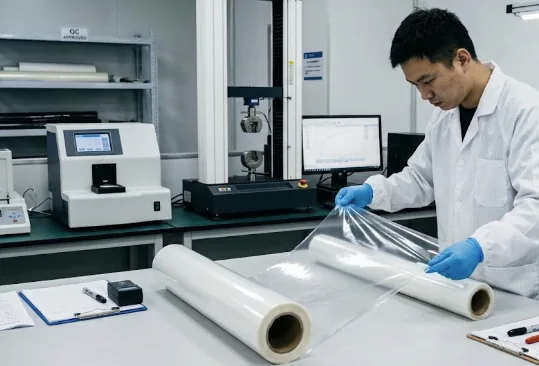
For Installers and Distributors: Testing Samples and Tracing Batches
If you are choosing a film to stock, test samples side by side before you commit, on the same panel, under the same light. Do the heat-healing test, leave a strip on for 48 hours and take it off, lay the film over black paint, and keep a sample in a sunny window for a few months to compare later.
Then look at what happens after the sale. Every roll we ship carries a lot number, and the install center registers each job against that number at handover through an electronic warranty, which links the car to the coating batch. Raw materials, work in progress and finished film are each checked before the batch moves on, and the record stays with it. If a claim ever comes in, that record is what lets the supplier answer with facts instead of opinions. Ask any supplier you are considering to show you how they would trace a roll from a car back to its coating run.
Frequently Asked Questions
Does PPF damage car paint?
No, not on healthy factory paint. The adhesive is designed to bond firmly and release cleanly with heat, so a trained installer can remove the film without lifting the clearcoat. The risk is on repainted panels, where poorly bonded aftermarket paint can come away with the film, so tell your installer about any repairs before the job.
Can you see paint protection film on a car?
Barely, if it is good film installed well. On gloss paint it usually reads as extra depth rather than a layer. What you may see up close is the edge line where film stops on a visible face of a panel. Wrapped edges hide that line, which is why full-body installs usually wrap them.
Can I take a car with PPF through a car wash?
Yes, after about a week. Touchless washes and careful hand washing are the safest options. Brush-type automatic washes can mark any finish and can catch a film edge, so avoid them where you can, and never let a pressure-washer nozzle point straight at an edge.
How soon can I wash my car after PPF is installed?
Wait about seven days. You can drive the car straight away, but the adhesive needs about 48 hours to reach full strength, and leftover moisture under the film needs a few days to clear. Washing too early, especially with a pressure washer, can lift edges that have not fully bonded.
Can you put PPF on a used car?
Yes, as long as the paint is corrected first. Film seals in whatever is underneath, so swirl marks, chips and contamination need to be polished out or repaired before installation. On an older car with heavy paint damage, the correction can be a large part of the bill, so price both together.
Does PPF stop rust and dents?
It does not stop dents, because it protects the surface rather than the panel itself. It does help prevent rust indirectly. Rust on body panels often starts at stone chips that break through to bare metal, so stopping the chips removes one of the most common starting points.
Can damaged PPF be repaired?
Light scratches repair themselves with heat. A cut or tear that goes through the film cannot be repaired in place, but only the film on that panel needs replacing, not the whole car. That is one of the practical advantages of film over paint: a damaged hood section is a short job, not a respray.
Is PPF the same as a clear bra?
Yes. Clear bra is the older American name for the same transparent film. Some shops use “clear bra” only for front-end coverage and “PPF” for wider coverage, so check exactly which panels are included when you compare quotes.
Can PPF be applied over matte paint?
Yes, but use a matte or satin film. A gloss film will make matte paint look shiny where it is applied, while a matte film keeps the original finish and protects it. Matte surfaces also need matte-safe cleaning products, since wax and polish would leave them patchy.
Do I need a ceramic coating on top of PPF?
No, the film protects the paint on its own. A coating is optional: it makes the surface even easier to clean and adds some gloss. If you want one, use a coating made for PPF and apply it after the film has settled, and check that it does not affect your film warranty.
The Short Version
Car paint protection film is a clear, elastic TPU layer that takes the stone chips, scratches, UV and chemical damage your paint would otherwise take. Good film heals light scratches, stays clear for years and comes off cleanly when it is time to replace it. Cheap film can look the same on day one and very different two years later. The difference comes down to the base polymer, the top coat, the adhesive and how carefully the film was made and installed.
If you install or distribute film and want to compare our HD range with what you stock now, use the Get a quote button on this page to ask for samples and the test data behind them.